

Marine Insurance Leader Club Marine Welcomes New CEO
The information on this website is general in nature and does not take into account your objectives, financial situation, or needs. Consider seeking personal advice from a licensed adviser before acting on any information.
In a notable shift in its leadership ranks, Club Marine, a key player in the marine insurance market and subsidiary of Allianz, has officially instated Tim Wiles as its Chief Executive Officer.
Wiles, having confidently steered the company since last November as interim CEO, has now been entrusted with the permanent leadership mantle.
With a wealth of experience accrued within Club Marine, starting from his origins as a junior underwriter back in 2007, Wiles has ascended the corporate ladder demonstrating his versatility across multiple domains including underwriting, client services, technical affairs, and product development. His appointment promises to uphold consistency and stability following the departure of former CEO Karen Te Maipi.
Ms. Jenita Wijaya, Acting General Manager Agencies at Allianz Australia Insurance, lauded Wiles’s unwavering dedication and adept leadership qualities, expressing optimism for the future as the company embarks on an evolutionary path under his guidance.
For Wiles, the new position is not just a professional achievement but a personal milestone, aligning with his passionate engagement in the marine sphere. His stewardship over the past half year not only reflects skilled management but also embodies his deep-rooted connection to the aquatic world and enthusiasm for boating.
As he assumes the official CEO role, Wiles is poised to further the success of Club Marine, building upon its reputation as Australia's foremost provider of recreational boat insurance and steering the firm towards new horizons in service excellence and market growth.
Please Note: We do not endorse any specific products or companies. Some content is sourced from third parties, including press releases, and may not be independently verified for accuracy or completeness.
Fresh industry concern about repair delays after severe weather is highly relevant for Australian farms, where a damaged shed, washed-out access track or unavailable part can quickly interrupt day-to-day operations. While the wider insurance discussion often focuses on homes and commercial buildings, the same pressure points can be even more complex on rural properties because assets are spread out, specialist equipment is involved and local contractor availability may be limited. - read more
Renewed industry pressure to reduce insurance taxes has put affordability back in the spotlight for rural and regional Australia. The latest debate centres on the extra costs added to insurance through state-based duties, levies and other charges, which can make already expensive cover harder to maintain for households and businesses exposed to flood, bushfire, storm and cyclone risk. - read more
Recent complaints data from the Australian Financial Complaints Authority has again highlighted a pressure point that matters to rural Australia: insurance claims can become difficult when expectations, policy wording and evidence do not line up. While the figures cover the wider insurance market rather than farms alone, the themes are highly relevant for agricultural businesses dealing with storm damage, fire losses, machinery failures, fencing repairs or interrupted operations. - read more
Australia's latest seasonal weather signals have again pushed rainfall risk into the foreground for rural and regional businesses. While conditions vary sharply between districts, a wetter outlook for parts of the country is a useful reminder that risk planning should not wait until paddocks are already saturated, creek crossings are cut or machinery is bogged at harvest. - read more
Fresh insurance industry concern about underinsurance is especially relevant for Australian farmers as rebuilding and replacement costs remain stubbornly high. While the issue is often discussed in relation to houses, the same pressure applies across rural assets: sheds, fencing, pumps, tanks, grain storage, livestock yards, irrigation equipment and machinery can all cost significantly more to replace than they did when a policy was first arranged. - read more
Australia's general insurance sector has again put natural hazard resilience at the centre of the affordability debate, with fresh industry commentary warning that floods, bushfires, storms and cyclones are continuing to reshape how risk is priced. For farmers, this is not an abstract policy discussion. It goes directly to the cost and availability of farm insurance, particularly for properties with older buildings, exposed machinery, flood-prone access roads, boundary fencing, stored fodder or high-value livestock. - read more
Cybersecurity refers to the practice of protecting systems, networks, and programs from digital attacks. In the context of agriculture, it involves safeguarding the digital solutions and technologies that have become intrinsic to modern farming operations. As technological advancements continue to revolutionize the farming landscape, the importance of cybersecurity in securing farm data and operations has become more pronounced. - read more
Farm business interruption insurance may help protect farm income and cover certain extra costs when an insured event disrupts operations. This guide explains how it works, what it may cover, where it differs from personal income protection and crop insurance, and what to check before relying on it. - read more
Choosing farm insurance starts with understanding the assets, activities and risks that make your farm different. From buildings and machinery to crops, livestock and liability exposures, the right policy structure depends on what you operate, what you own and how your farm could be affected by events such as storms, fire, theft, accidents or other disruptions. - read more
In the ever-evolving landscape of modern agriculture, the security and stability of a farm hinge on thorough preparation and strategic foresight. A pivotal component in safeguarding a farm's future lies in the critical role of on-farm risk assessment. This process provides a structured approach to identifying potential risks that could affect a farm's operations, financial health, and overall sustainability. - read more
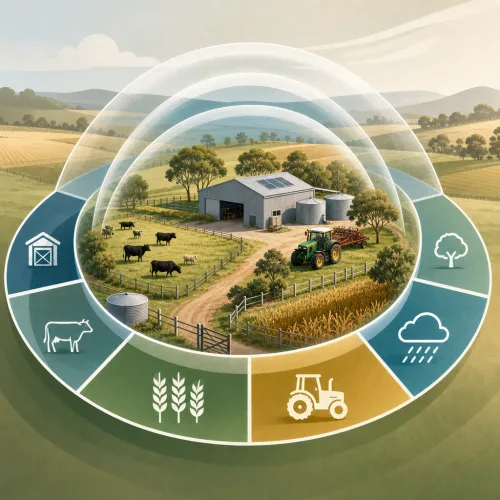
Farm equipment insurance helps rural Australians manage the financial risk of damage, theft or loss involving essential agricultural machinery. Understanding what may be covered, what is commonly excluded and how claims are handled can make it easier to compare policies and keep cover aligned with changing farm operations. - read more
Persistent drought can place sustained pressure on Australian farm income, cash flow, livestock management, crop production and long-term investment decisions. A practical drought financial plan can help farm owners assess risks, control costs, preserve flexibility and make more informed decisions during extended dry periods. - read more
Need a Quote?
Start your free farm insurance quote comparison here.
Knowledgebase
Subrogation: An insurance carrier may reserve the "right of subrogation" in the event of a loss. This means that the company may choose to take action to recover the amount of a claim paid to a covered insured if the loss was caused by a third party.
No comments yet. Be the first to share your thoughts.