

Medical Professional Coverage Costs Under Scrutiny
The information on this website is general in nature and does not take into account your objectives, financial situation, or needs. Consider seeking personal advice from a licensed adviser before acting on any information.
Amid rising concerns, the Australian Medical Association (AMA) has flagged the escalating expenses associated with indemnity insurance premiums as a serious issue that demands attention.
Following a heated discussion at a recent national conference held on the Gold Coast, the AMA and its New South Wales branch convened with a number of medical defence organisations to tackle this pressing matter.
During these meetings, participants delved into changes in healthcare delivery and the evolving scopes of medical practice—factors contributing significantly to the rising costs within the medical indemnity sector.
According to a statement published on the AMA’s website, the Medical Defence Organisations (MDOs), which largely operate as member-based mutual entities, acknowledged the industry's growing unease. They shared global insurance market trends and emphasized the importance of maintaining open communication and collaborative efforts with the AMA to address systemic policy issues. Despite the need for cooperation, the constraints of competition law were noted as a limiting factor.
The organizations represented at the meeting included key industry players such as Avant, MDA National, Medical Indemnity Protection Society, MIGA, and Tego.
In its latest report, Avant informed Insurance News that their average rate increments have managed to remain below inflation for several renewal periods. Nevertheless, certain specialized fields have experienced sharp double-digit rate hikes due to specific claim frequencies and severities, affecting less than 1% of their membership.
Please Note: We do not endorse any specific products or companies. Some content is sourced from third parties, including press releases, and may not be independently verified for accuracy or completeness.
Fresh industry concern about repair delays after severe weather is highly relevant for Australian farms, where a damaged shed, washed-out access track or unavailable part can quickly interrupt day-to-day operations. While the wider insurance discussion often focuses on homes and commercial buildings, the same pressure points can be even more complex on rural properties because assets are spread out, specialist equipment is involved and local contractor availability may be limited. - read more
Renewed industry pressure to reduce insurance taxes has put affordability back in the spotlight for rural and regional Australia. The latest debate centres on the extra costs added to insurance through state-based duties, levies and other charges, which can make already expensive cover harder to maintain for households and businesses exposed to flood, bushfire, storm and cyclone risk. - read more
Recent complaints data from the Australian Financial Complaints Authority has again highlighted a pressure point that matters to rural Australia: insurance claims can become difficult when expectations, policy wording and evidence do not line up. While the figures cover the wider insurance market rather than farms alone, the themes are highly relevant for agricultural businesses dealing with storm damage, fire losses, machinery failures, fencing repairs or interrupted operations. - read more
Australia's latest seasonal weather signals have again pushed rainfall risk into the foreground for rural and regional businesses. While conditions vary sharply between districts, a wetter outlook for parts of the country is a useful reminder that risk planning should not wait until paddocks are already saturated, creek crossings are cut or machinery is bogged at harvest. - read more
Fresh insurance industry concern about underinsurance is especially relevant for Australian farmers as rebuilding and replacement costs remain stubbornly high. While the issue is often discussed in relation to houses, the same pressure applies across rural assets: sheds, fencing, pumps, tanks, grain storage, livestock yards, irrigation equipment and machinery can all cost significantly more to replace than they did when a policy was first arranged. - read more
Australia's general insurance sector has again put natural hazard resilience at the centre of the affordability debate, with fresh industry commentary warning that floods, bushfires, storms and cyclones are continuing to reshape how risk is priced. For farmers, this is not an abstract policy discussion. It goes directly to the cost and availability of farm insurance, particularly for properties with older buildings, exposed machinery, flood-prone access roads, boundary fencing, stored fodder or high-value livestock. - read more
Hobby farming may not be your main source of income, but it can still be financially important. If illness or injury prevents you from working, income protection insurance may help replace part of your income while you recover, depending on the policy terms. - read more
Livestock insurance can help Australian farmers manage the financial impact of unexpected animal losses caused by events such as disease, accidental death, theft, transit incidents or extreme weather. The right policy settings depend on the type of livestock, the risks faced by the farm, how animals are valued and the exclusions that apply. - read more
The world of farming is one filled with uncertainties. Weather conditions, market prices, and various other factors can create a highly volatile income stream for those within the agricultural sector. This unpredictability can lead to financial instability that impacts not only the farmers themselves but also their families and the larger rural community. - read more
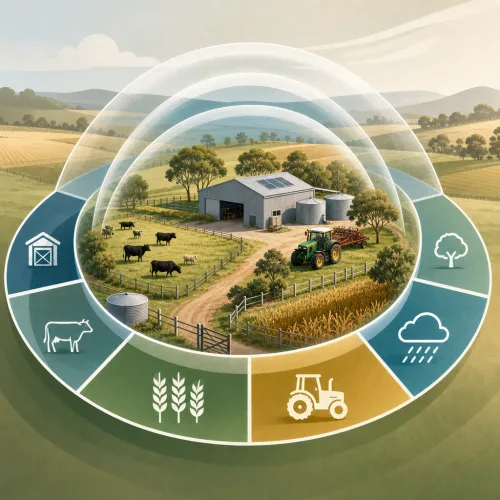
Choosing farm insurance starts with understanding the assets, activities and risks that make your farm different. From buildings and machinery to crops, livestock and liability exposures, the right policy structure depends on what you operate, what you own and how your farm could be affected by events such as storms, fire, theft, accidents or other disruptions. - read more
Farm property insurance can help protect the fixed assets on rural land, including farm buildings, sheds, fencing, tanks, yards and other infrastructure. This guide explains what may be covered, how values are usually reviewed and what details to check before comparing policy options. - read more
Crop farming carries risks that are often outside a farmer's control. Weather events, pests, crop failure and market changes can all affect production and farm income. Crop insurance is designed to provide a financial safety net when insured crops are damaged, destroyed or produce less than expected, helping farmers manage the business impact of an adverse season. - read more
Need a Quote?
Start your free farm insurance quote comparison here.
Knowledgebase
Copayment: A fixed amount you pay for a covered healthcare service, usually when you receive the service.
No comments yet. Be the first to share your thoughts.